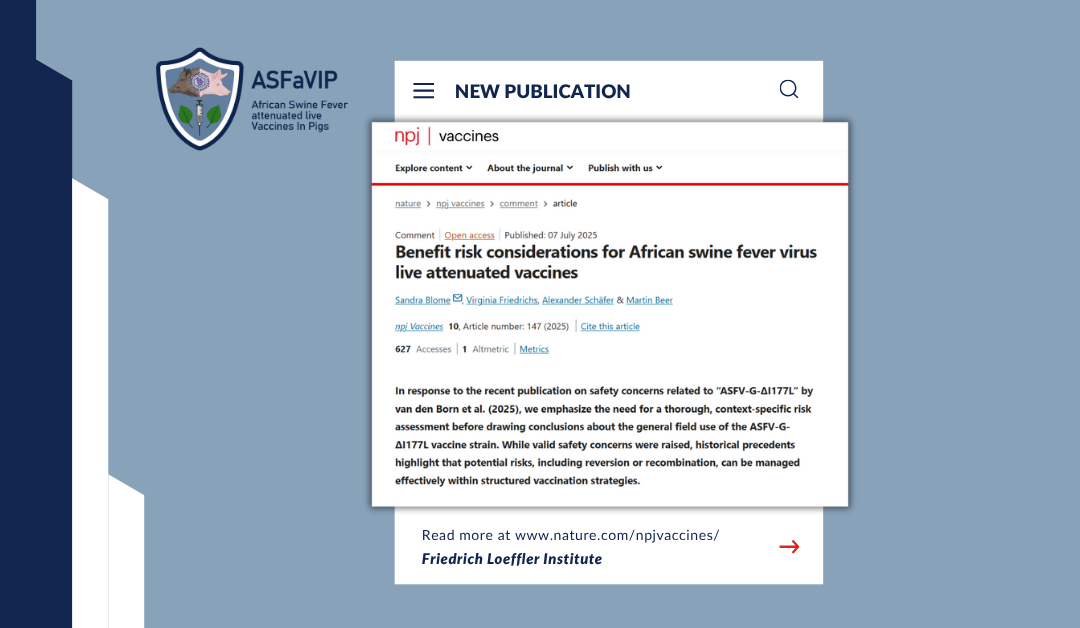
Our partner Friedrich-Loeffler-Institut Federal Research Institute for Animal Health, including Sandra Blome, Virginia Friedrichs, Alexander Schäfer, and Martin Beer, has recently published an article discussing benefit-risk considerations for the ASFV-G-∆I177L live attenuated vaccine.
The authors address recent findings about the potential reversion to virulence of the ASFV-G-∆I177L strain, particularly after forced passages in the lab. While caution is warranted, a context-specific and thorough risk assessment is essential before making conclusions about its general field use.
📊 Examples from other live attenuated vaccines:
The GPE−strain vaccine against Classical Swine Fever (CSF) showed increased virulence in experimental studies but is still used in the field with no indications of virulence.
Modified live vaccines for Aujeszky Disease and BoHV-1 also raised concerns about recombination with virulent field strains, but with proper herd management, risks have not been a significant issue in practice.
🔍 Conclusion: While the use of ASFV-G-∆I177L as a prophylactic measure might be concerning, its application in emergency situations could be justified given the otherwise high fatality rates of field ASFV strains. Further studies on vaccine reversion and transmissibility are needed to refine vaccination strategies that are context-specific and tailored for different outbreak scenarios.
➡️ Read the full publication: https://www.nature.com/articles/s41541-025-01208-8
#ASF #Vaccine #AnimalHealth #Research #VaccineDevelopment #AfricanSwineFever