Structure & Governance
Structure & Governance
Consortium members

FLI, the German Federal Research Institute for Animal Health, operates high-containment laboratory and animal facilities licensed to handle animal pathogens and GMOs up to risk group 4, including ASFV. FLI is the German national reference laboratory (NRL) for all notifiable animal diseases. Previous work at FLI includes the generation and testing of vaccine candidates (e.g. safety and efficacy trials, reversion to virulence), optimization of diagnostic workflows and work into immunology and pathogenesis of ASF (including studies in mature boars and pregnant sows as well as wild boar). FLI will manage the project (WP10), facilitate communication (WP9) and perform research related to different WPs.

Wageningen Research (WR)
Stichting Wageningen Research (WR) is part of the Wageningen University and Research Centre. One of the institutes of WR is Wageningen Bioveterinary Research, which is the Dutch national reference institute for all notifiable animal diseases. Except for human BSL4, WBVR has access to all levels of high containment facilities up to veterinary BSL4, with facilities for large and small animals. WBVR has worked on African swine fever diagnosis, pathogenesis, epidemiology and vaccination, partly in collaboration with FLI, IVI, and Sciensano. WBVR will lead WP5 (efficacy studies in domestic pigs) and will conduct animal experiments within WPs 1, 2, 4, and 5 with subsequent work into correlates of protection and immunology.

Sciensano
Sciensano is a public institution with legal personality and works on both public and animal health. Sciensano is the National Reference Laboratory for all notifiable animal diseases and harbors animal facilities of all relevant safety levels including ASFV and derived GMOs vaccines. Sciensano (and its predecessor Veterinary and Agrochemical Research Centre) has long-standing expertise in EU-funded projects. The institution is currently involved in several ASF related research projects (including ASF-RASH) and was responsible for CSFV_goDIVA, the project that led to licensing of the CSF marker vaccine virus CP7_E2alf. Sciensano has built expertise in pathology study and safety evaluation of ASFV candidate vaccines in partnership with private companies. Sciensano will lead WP4 and conduct studies on vaccine comparison, safety and efficacy in WPs 1, 4 and 5.

The Institute for Game and Wildlife Research
The Institute for Game and Wildlife Research at the University of Castilla (UCLM), and especially the Research Group in Health and Biotechnology (SaBio) is one of the main European references in the transdisciplinary research between ecology, biotechnology and animal health. SaBio’s research covers all aspects of animal health: zoonosis, diagnosis, epidemiology and control. The two main lines of work focus on the epidemiology and control of infections shared with wildlife such as tuberculosis or African swine fever, as well as in vector and transmitted diseases including vaccine development. Within the ASFaVIP project, UCLM will lead WP7 and work on the assessment and optimization of vaccine bait uptake, explore biomarkers and help designing immunization concepts for wild boar.
The Helmholtz Centre for Environmental Research – Department of Ecological Modelling (UFZ)
The Helmholtz Centre for Environmental Research – Department of Ecological Modelling (UFZ) is dedicated to interdisciplinary research regarding interactions between man and environment. UFZ is involved in numerous national and international research networks, and in initiatives aiming at policy advice. The Department of Ecological Modelling (OESA) of the UFZ is one of the largest groups of applied modellers worldwide. The agenda of the Project Group Ecological Epidemiology (EcoEpi) combines transdisciplinary research across epidemiology, ecology, and food production into support and advice of plant health, animal health and welfare. The central paradigm is to understand population scale pathogen spread and its control based on the behavioural decisions of individual entities or regulatory alternatives. The research philosophy supports risk assessment, decision making under uncertainty, evaluation of management measures and policy advice. The developed software tools resulted in guidelines and strategic adoptions of national, EU and WHO health management programs. EcoEpi maintains a long-standing model of ASF in wild boar and can now address disease dynamics with and without interventions. UFZ leads WP8 and will integrate the knowledge gained in the project into the planning and design of adequate vaccination concepts and evaluate their pros and cons. Additionally, the technical tools assist in testing working hypotheses on the vaccination approach with the targeted vaccine.

The International Alliance for Biological Standardization Europe (IABS-EU)
The International Alliance for Biological Standardization Europe (IABS-EU) is an association governed by the French law. IABS-EU’s primary objective is to support the mission and projects of IABS and to enhance its image within Europe. IABS-EU is contributing to scientific and medical advancement of biologicals, by facilitating communication among those who develop, produce, and regulate biological products for human and animal health. More specifically, it will focus on issues concerning the regulation and standardization of biological products that are intended for market use. IABS-EU will lead WP9 supporting the communication with regulatory bodies and other relevant stakeholders. IABS-EU will organize the kick-off meeting and a stakeholder workshop.

Büro Wildvet
Büro Wildvet is a German private company assisting veterinary authorities to deal with ASF management measures in wild boar populations, particularly regarding population reduction through trapping, restriction of movements through fences and management of carcasses in the environment. They will monitor and disseminate information on the behaviour of wild boar movements in fenced infected ASF areas. Moreover, Büro Wildvet will help collecting non-invasive samples from wild
Institute of Food Safety, Animal Health and Environment “BIOR” (Latvia)
The Institute of Food Safety, Animal Health and Environment “BIOR” is Latvia’s national research institute for animal health and food safety, with strong expertise in African swine fever (ASF) and wild boar ecology. BIOR contributes to ASFaVIP through field trials supporting the design of innovative oral vaccine baits and the monitoring of bait uptake using novel biomarkers. The institute develops non-invasive sampling methods based on saliva and environmental samples, leads ecological studies of wild boar populations using camera traps and GPS-collaring, and analyses ASF spread in Latvia to support improved disease control strategies.
Associate partners
Institute of Virology and Immunology (IVI)
An important Associate Partner is the Institute of Virology and Immunology in Mittelhäusern, Switzerland (IVI). The IVI has strong research collaborations with all partners involved in animal studies and is a reference when it comes to swine immunology. Building on experience gained in the ongoing ASF-RASH project, IVI will lead WP1 and employ systems immunology-based characterization of immune responses to identify correlates of protection and disease, study antibodies and innate responses, and identify host cellular factors using differential transcriptomics (WP1). Moreover, IVI work towards a new generation of innovative vaccines against ASFV trying to direct and orchestrate immune responses (WP2).

Zoetis Manufacturing and Research Spain SL (Zoetis)
Zoetis Manufacturing and Research Spain SL (Zoetis) located in Vall de Bianya/Olot (Girona), Spain, is a laboratory specialized in the development and production of immunological and pharmaceutical products for animals. The facilities of Zoetis include a modern manufacturing plant equipped with state-of-the-art technology that fully complies with Good Manufacturing Practice standards (GMP Certificate). Zoetis has been involved in previous EU-funded projects on ASF (e.g., ASFORCE, DEFEND) and CSF (CSFV_goDIVA) and funded research on vaccines in several research institutions including FLI.

The Plum Island Animal Disease Center (USDA)
The Plum Island Animal Disease Center (USDA) is protecting the US agriculture against the accidental, natural, or intentional introduction of transboundary animal diseases (TADs), including African Swine Fever (ASF). The pilot vaccines used in the ASFaVIP project have been designed by USDA. Within the project, USDA will provide input and guidance regarding vaccine testing, especially with breeding animals at FLI, provide input on correlates of protection and design of potential DIVA candidates, and ensure that regulatory issues applying to US licensing are integrated.
Governance
Steering Committee
Aivars Bērziņ, BIOR
Sandra Blome, Friedrich-Loeffler-Institut
Manuel Borca, U.S. Department of Agriculture
Julian Dorsch, WildVet
Christian Gortazar, Universidad de Castilla-La Mancha
Carmen Jungbäck, International Alliance for Biological Standardization – Europe (IABS-EU)
Nadia Oreshkova, Wageningen University & Research
Artur Summerfield, University of Bern / Institute of Virology and Immunology
Hans-Hermann Thulke, Helmholtz Centre for Environmental Research – UFZ
Marylene Tignon, Sciensano
Elisenda Viaplana, Zoetis
Executive Board
Nadjah Radia Adjaj, Sciensano
Madinina Cox, IABS-EU
Virginia Friedrichs, Friedrich-Loeffler-Institut
Christian Gortazar, Universidad de Castilla-La Mancha (UCLM)
Nolwen Husson, Institute of Virology and Immunology (IVI)
Carmen Jungbäck, International Alliance for Biological Standardization – Europe (IABS-EU)
Marlène Martins , IABS-EU
Kemal Mehinagic, Institute of Virology and Immunology (IVI)
Laurent Mostin, Sciensano
Nadia Oreshkova, Wageningen Bioveterinary Research (WBVR)
Alexander Schäfer, Friedrich-Loeffler-Institut
Milena Stillfried, WildVet
Artur Summerfield, Institute of Virology and Immunology (IVI)
Hans-Hermann Thulke, Helmholtz Centre for Environmental Research (UFZ)
Marylene Tignon, Sciensano
Alicia Urniza, Zoetis
Elisenda Viaplana, Zoetis
Sandra Vreman, Wageningen Bioveterinary Research (WBVR)
Agnes Watillon, Sciensano
Edvīns Oļševskis, Food and Veterinary Service of Latvia (PVD)
Scientific Advisory Board
Aruna Ambagala, Canadian Food Inspection Agency (CFIA)
Erika Chenais, National Veterinary Institute of Sweden (SVA)
Thomas Bruun Rasmussen, Statens Serum Institut
Thomas C. Mettenleiter, Friedrich-Loeffler-Institut
Ann Sofie Olesen, Statens Serum Institut
Kim Pepin, United States Department of Agriculture (USDA)
Karl Ståhl, National Veterinary Institute of Sweden (SVA)
Etienne Thiry, University of Liège
David Williams, Commonwealth Scientific and Industrial Research Organisation (CSIRO)
Ethics Advisor
Thomas Blaha, University of Veterinary Medicine Hannover
Working Plan
The activities of ASFaVIP have been structured under an umbrella of four overarching themes in eight scientific work packages (WPs) and two WPs dedicated to D&E&C and management. The ten WPs with 26 tasks cover all activities required to reach the objectives of the project. Within Theme 1, “Establish standards and define correlates and mechanisms of protection”, WP1 will target multi-centre studies using established vaccine candidates (i.e., “ASFV-G-ΔI177L”, “ASFV-G-ΔMGF” and “ASFV-G-Δ9GL/UK”) and comparators to achieve harmonization of immunization and challenge, laboratory procedures and clinical and pathological read-out. Furthermore, WP1 will make use of the sample repository to identify correlates and mechanisms of protection and immunopathology. It harbours our main immunological studies and will comprise experiments to define host and virus genetic factors. Within Theme 2, “Explore possibilities to generate innovative next generation vaccine approaches”, WP2 will tackle the next generation of innovative vaccination concepts, i.e., further development of effective candidates with DIVA potential, expression of new antigens, and integration of elements that direct the immune system towards beneficial reaction pattern. WPs 3, 4, 5 and 6 comprise the studies meant to move the pilot vaccine “ASFV-G-ΔI177L” towards central licensing at the European Medicines Agency (Theme 3). In more detail, WP3 will deal with the production and quality management of pilot vaccines and the development of DIVA options, WP4 will cover relevant safety studies, WP5 the efficacy trials, and WP6 proof-of-concept trials in wild boar. Given that the WOAH guidelines for ASF vaccine testing are currently being developed and agreed, we will align and adapt our animal studies at the start of the project (at the kick-off meeting) to these new guidelines, to which two of the consortium partners have actively contributed (P1, AP3). This will ensure that the studies are suitable for dossier submission and meet the current requirements. The current design has been prepared considering the requirements of the European Pharmacopoeia for live vaccines in the veterinary sector. These guidelines are also reflected in principle in the new WOAH guidelines but will need adjustments. Considering the results obtained in the above-mentioned WPs and previous knowledge, Theme 4 will set out to “Design and validate vaccination concepts for domestic pigs and wild boar”. Within Theme 4, WP7 will deal with the design and optimization of oral vaccination considering wild boar ecology in affected regions, and WP8 will model vaccination in populations of domestic pigs and wild boar. WPs 9 and 10 are concerned with dissemination and communication activities and project management. The former includes survey of ethical aspects and contact with regulatory bodies.
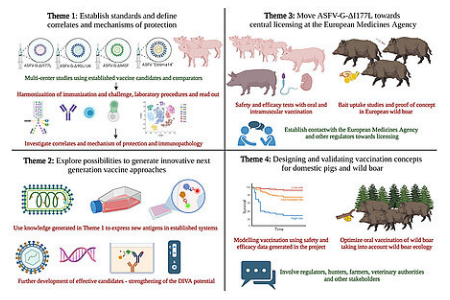
ASFaVIP Themes (© ASFaVIP)
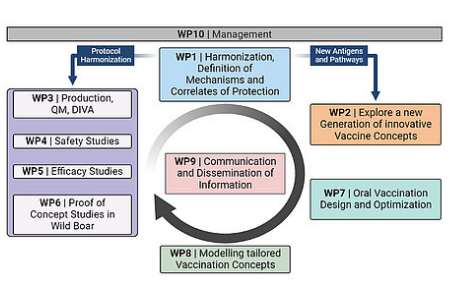
WP Structure (© ASFaVIP)